Job autonomy and stress both impact job satisfaction. Having autonomy over our work boosts satisfaction, while high levels of stress can lead to burnout.
But how do autonomy and stress interact? Is autonomy a silver bullet that nullifies the impact of stress? Or does job stress lead to negative outcomes even when autonomy is high?
To examine the interaction between these two factors, we analysed nearly two decades of the HILDA survey. The sample covered over 163,000 observations from more than 22,000 workers from 2005–2023. We used a Bayesian mixed-effects model to examine how stress and autonomy interact to predict job satisfaction, after controlling for a host of other factors like age, gender, income, and industry.
The analysis revealed four key insights:
- The Basics Hold True: Unsurprisingly, higher stress was linked to lower job satisfaction, while higher autonomy was linked to higher job satisfaction.
- Autonomy is a Buffer (to a point): When stress was high, autonomy cushioned the negative impact. However, highly stressed employees were still less satisfied than average, even when autonomy was high.
- Autonomy's Effect Reduces When Stress is Low: For employees with very low stress, having more autonomy made little difference to their job satisfaction.
- The "Sweet Spot": The most satisfied employees weren't those with low stress. Satisfaction actually peaked when high autonomy was combined with moderate stress.
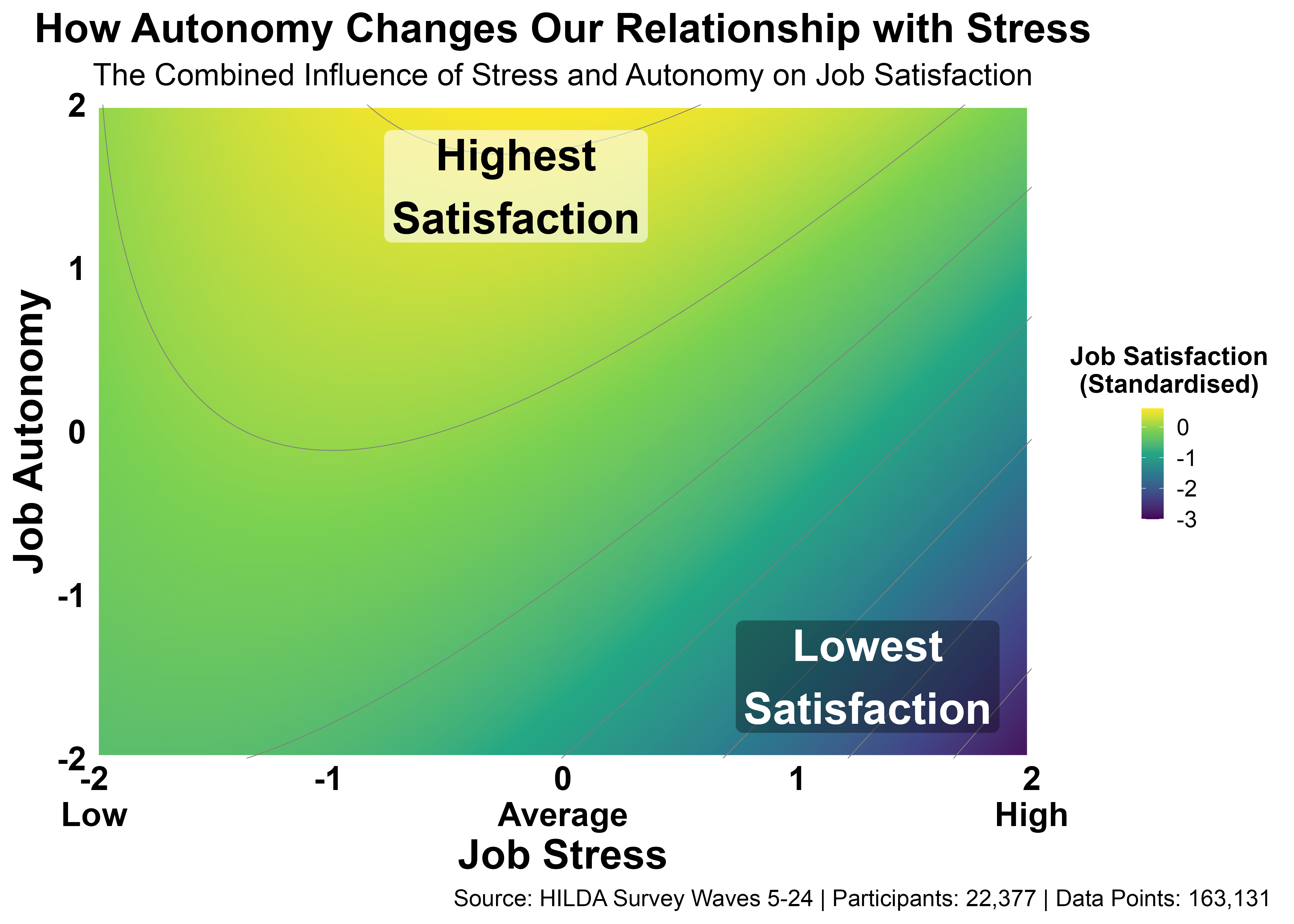
This suggests that the ideal job isn't one with no challenges. A "sweet spot" exists where employees have enough stimulation to stay engaged and challenged, but also the freedom to decide how they meet those challenges.
For leaders, the goal shouldn't be to eliminate all sources of stress, but to empower their teams with the trust and control needed to thrive under it.