Rahimi et al. recently published Australian benchmarks for the Copenhagen Psychosocial Questionnaire (COPSOQ III). The COPSOQ is one of a handful of validated tools endorsed by Australian WHS regulators for assessing psychosocial hazards in the workplace.
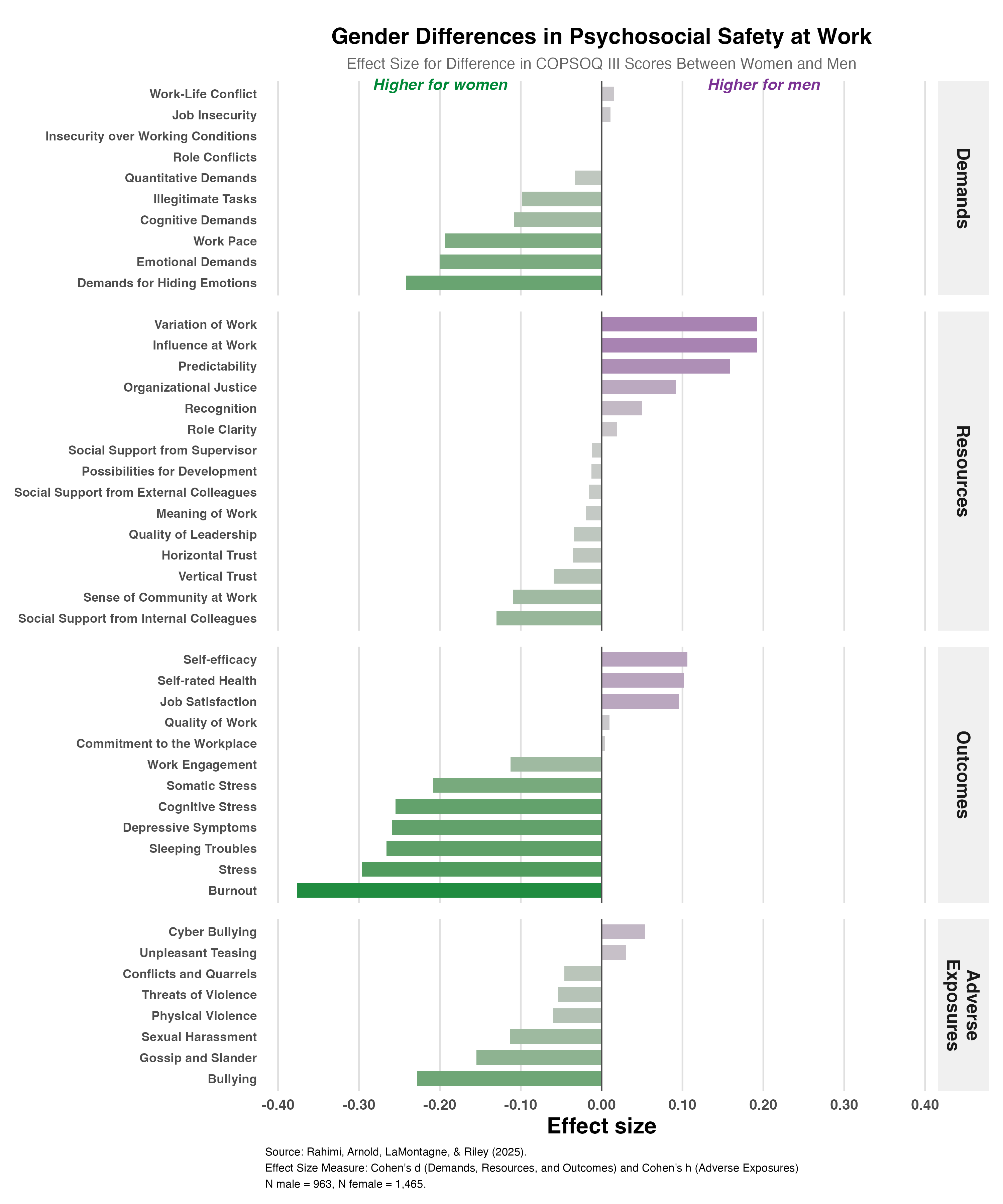
Not only did the authors provide benchmarks for the Australian working population as a whole, they also benchmarked across different demographics and industries. The results for gender are particularly interesting. The plot below shows the effect size for differences between men and women across demands, resources, outcomes, and adverse exposures.
Here are some of the key findings:
1) Women scored higher on many demands, with the largest differences in demands for hiding emotions, emotional demands, and work pace.
2) Men reported higher access to several resources, particularly variation of work, influence at work, and predictability. However, some resources were stronger for women, including social support from internal colleagues and sense of community at work.
3) Women scored higher on negative outcomes, especially burnout, stress, and depressive symptoms. Men scored higher on positive outcomes such as self-efficacy, self-rated health, job satisfaction, though these effects were small.
4) Women reported higher exposure to bullying, gossip and slander, sexual harassment.
The pattern here is quite consistent. Women are reporting higher demands, fewer resources, worse health outcomes, and greater exposure to adverse behaviours at work. The findings also raise some interesting questions about how we should be benchmarking. Is it more appropriate to benchmark against the general population or against a particular demographic? If women in your organisation are faring better than women in this study, is that enough?
In any case, studies like this strengthen the case for using the COPSOQ. Not only can organisations now benchmark their results against a sample that's representative of the Australian working population, they can also compare across specific sub-groups like gender, industry, and work status. That kind of granularity matters, because organisation-level averages can easily mask important differences between groups.
If you're interested in using the COPSOQ III to assess psychosocial risk in your organisation, feel free to reach out.