We've all heard the saying, "Employees don't leave jobs, they leave managers". But what about leaving due to overwork or lack of flexibility? Imagine two employees: One enjoys the freedom to adjust their schedule as needed, but often logs 55-hour weeks. The other works a strict 9-to-5 with no flexibility at all. Who is more likely to quit?
To pinpoint which matters more (and whether a flexible schedule can offset heavy workloads), we analysed two decades of Australian data from the HILDA survey, which has tracked over 20,000 people living in Australia since 2001.
Flexibility and Long Hours: What the Data Show
Our analysis focused on 21,217 workers followed over time since 2001, examining whether they changed jobs each year. We modelled the odds of an employee leaving their job within the next year as a function of "flexibility satisfaction" and long work hours (whether they worked more than 50 hours per week), while controlling for gender and age.
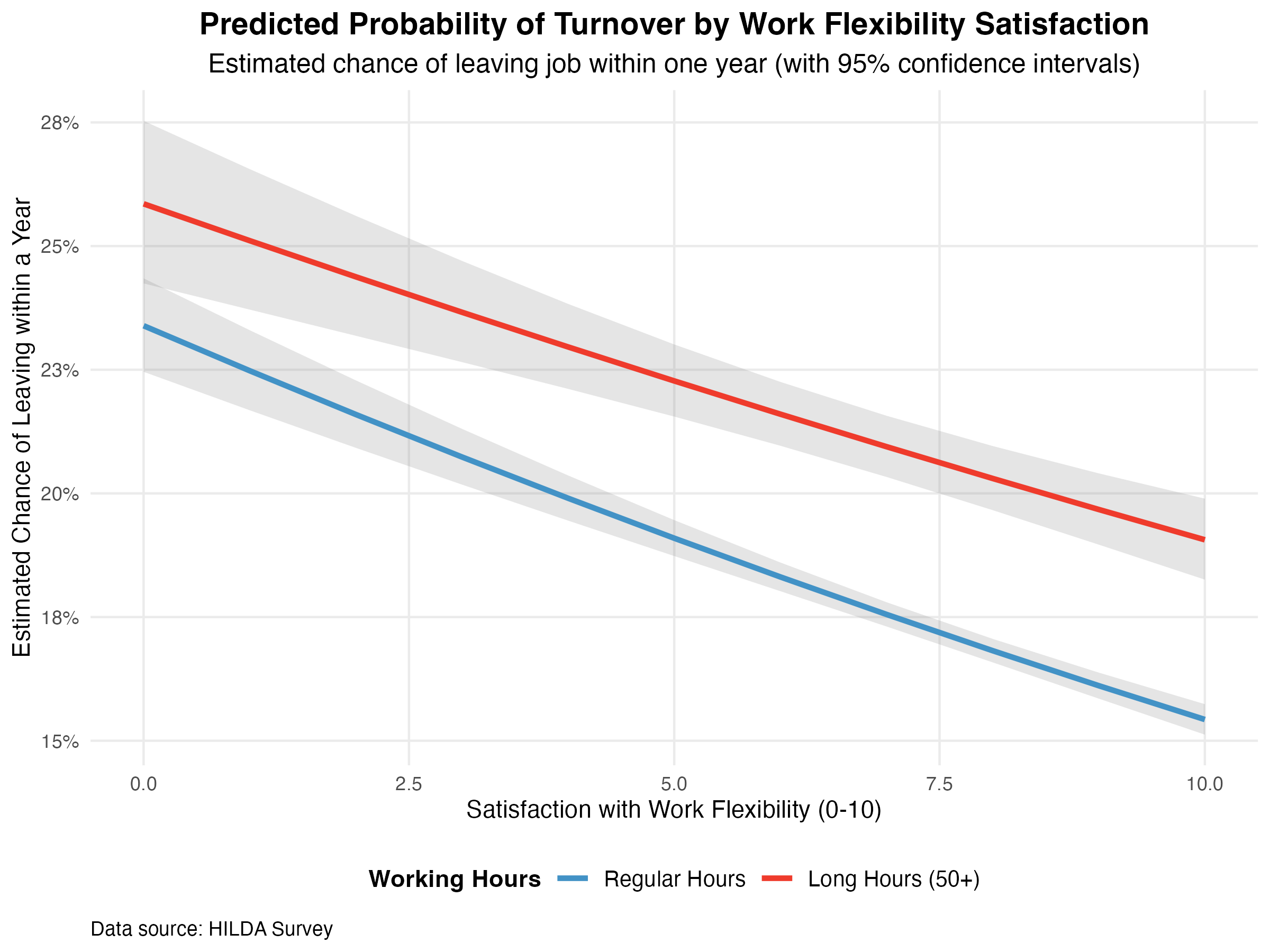
Both lines slope downward, indicating that higher flexibility satisfaction corresponds to lower turnover risk. However, the red line (long hours) is consistently higher than the blue line (normal hours) across all flexibility levels, revealing that consistently working 50+ hours a week was associated with approximately 9% higher odds of leaving compared to those working standard hours.
We also tested whether flexibility could buffer the negative impact of long hours but found no significant interaction effect — even employees with high flexibility who worked long weeks were still more likely to quit than those working normal hours. This illustrates that working long hours increases attrition risk regardless of flexibility, and while improving flexibility helps reduce turnover, it cannot entirely overcome the impact of excessive workloads.
Overwork and Flexibility: Finding the Balance
These findings send a clear message: work-life balance isn't one-dimensional. You can't simply throw flexible schedules at employees and ignore the number of hours they're working. Flexibility does make a big difference — it empowers employees to juggle their job with life's demands, thereby reducing stress and giving people fewer reasons to quit.
However, burning the midnight oil still carries a cost. Long hours can lead to exhaustion, health issues, and strained personal relationships — no amount of schedule control completely fixes that.
The ideal scenario for retention is high flexibility coupled with reasonable hours. Employees who can manage their work-life demands and aren't stretched too thin are the most likely to stay. If either element is out of balance (zero flexibility or extreme hours), retention suffers. For employers, the lesson is to address both sides of the equation: create flexible cultures but also monitor workload creep.
Keeping Your Team Onboard: What Employers Can Do
Promote Flexible Work Options: If you haven't already, consider policies like flexible schedules, remote work, or compressed work weeks. Ensure employees are aware of and encouraged to use these options without stigma.
Curb Chronic Overtime: Pay attention to teams or roles where 50+ hour weeks are the norm. This is a red flag for burnout and future turnover. Intervene by redistributing workloads, hiring additional staff, or setting clearer expectations that long hours are for occasional surges only, not a constant requirement.
Monitor Workload and Satisfaction: Use employee surveys to gauge flexibility satisfaction and burnout levels. If you see low flexibility scores or reports of overwork, act fast.
No One-Size-Fits-All: Recognise that needs differ. Some employees don't mind extra hours if they can do them on their own schedule; others fiercely protect their evenings. Tailor solutions where possible.