I shared some findings last week showing that full-time workers now spend about half as much time with friends as they did 20 years ago, and that colleagues have not filled the gap (see previous post). A few people asked a really good follow-up question: "Where has that time gone?"
So I explored that further, using 17,261 weekend diaries again from full-time workers in the American Time Use Survey, collected in 2003-05 and 2023-25. This time, I focused on weekends because that is when people have the most choice over how they spend their time.
Turns out, this is actually a little tricky to answer. You could ask "What are the activities we used to do with friends, and how have these changed?", but this doesn't tell you what's replacing them. To get a better idea of what's filling the gap, we need to look at what people are doing without friends now, at the same time of day, among the same sorts of people who would previously have spent that time with friends.
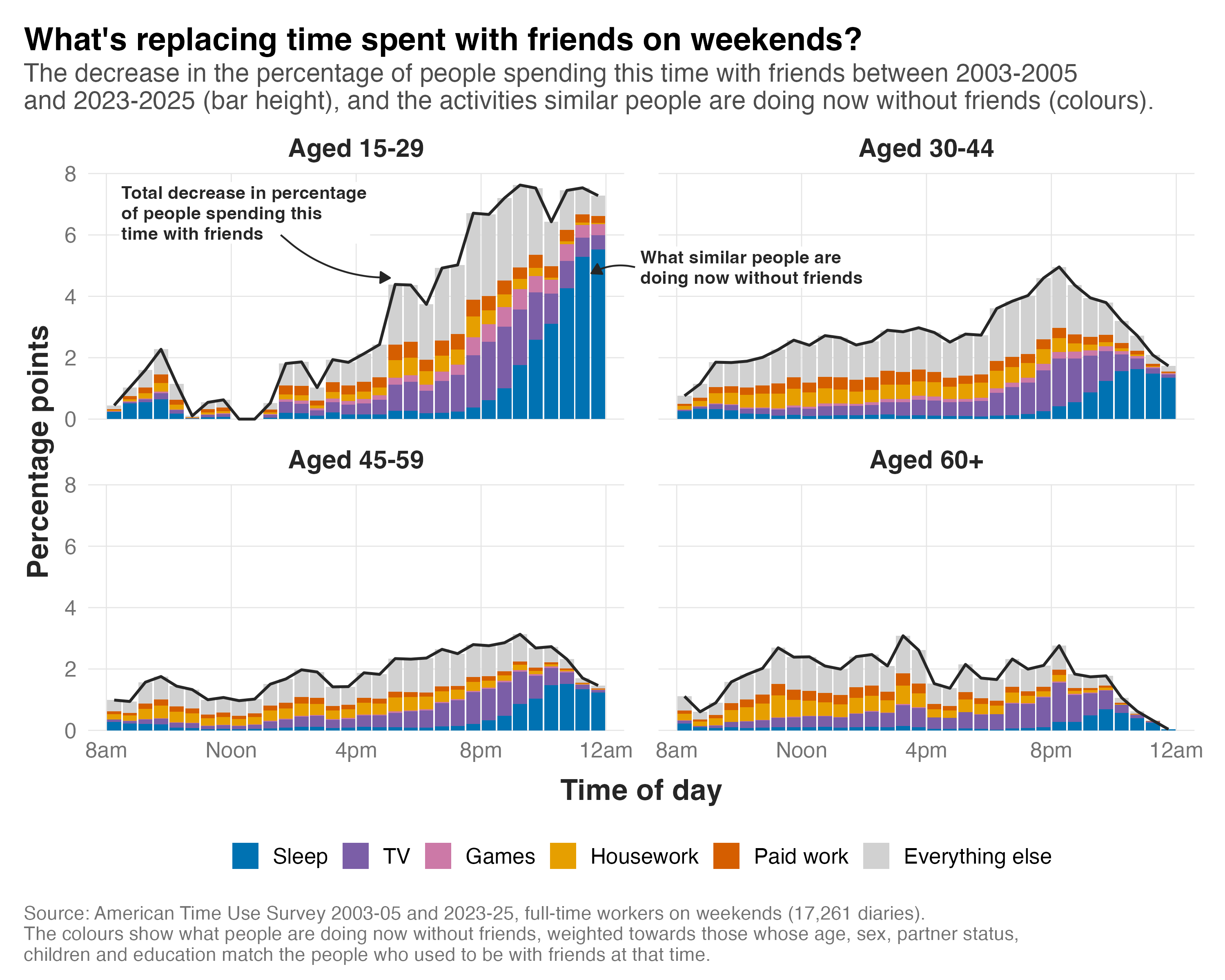
The figure below shows this for four age groups. The black line that traces the top of each bar shows how much the percentage of people spending that half-hour with friends has fallen. The colours divide that fall according to what similar people are doing now without friends.
Here's what I found:
1) The biggest falls are among younger workers in the evening. The percentage of folks under 30 who are with friends at 9pm has fallen by about 8 points. For people between 30 and 44, it's fallen by about 4 points.
2) In the early evening, TV is filling the largest share of the gap. At 8pm, TV accounts for 29 per cent of the lost time with friends for workers under 30, rising to 46 per cent for workers aged 60 and over.
3) Later in the evening, sleep is filling the largest share of the gap. By 10pm, sleep accounts for about half of the lost time with friends in every age group.
4) During the day, no single activity is filling the gap. Around 2pm, TV, housework and paid work each account for roughly 10 to 20 per cent of the lost time with friends for most age groups.
The American Time Use Survey isn't longitudinal. Each person completes a single diary, so we can't observe these changes as directly as if we tracked the same individuals over time. But what we can say is that more than half of the time lost with friends on weekends falls between 6pm and 1am, and that the people most likely to have lost it are now spending those evening hours largely watching TV and sleeping.