Last week I shared data showing that worker mental health has declined over the past decade, driven by both individual deterioration (a given worker will likely have poorer mental health today than they did 10 years ago) and compositional change (newer workers are entering with lower baseline mental health than those retiring).
A good follow-up question that some of you asked was "how do these trends differ by age or career stage?" Is this most recent generation of new workers starting off with worse mental health? Or is it just that young workers have always struggled more?
The data suggest it's mostly a cohort effect.
The left panel in the figure below tracks the same people over time by birth decade. Around 2010, workers born in the 1960s, 70s, 80s, and 90s all reported similar mental health. Since then, the younger the cohort, the steeper the decline. And since entering the workforce more recently, those born in the 2000s have reported the lowest mental health of any group.
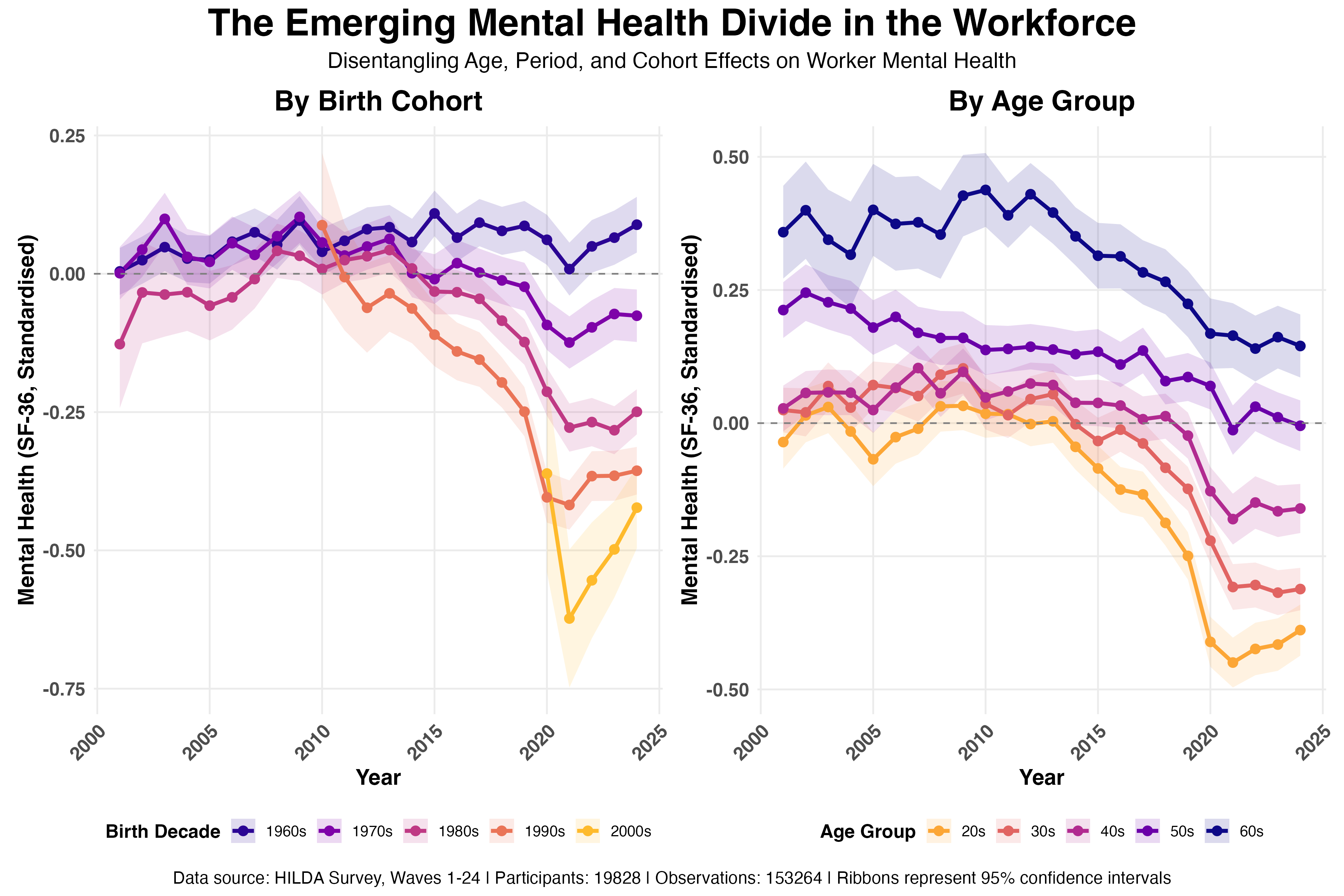
The interesting thing is that, if younger workers have always had worse mental health, we'd expect to see consistent gaps between age groups across all time periods.
That's not what the data show.
The right panel tracks mental health by age group over time (noting that different people occupy each age bracket at different points). Up until around 2010, there was essentially no difference between workers in their 20s, 30s, or 40s. It's only in the last 15 years that these groups have diverged.
I say mostly a cohort effect because workers in their 50s and 60s have consistently reported better mental health since 2001. So there does appear to be some benefit for those at later career stages. But even these older groups are now reporting lower mental health than they did a decade ago, likely as people from more recent birth cohorts age into them.
So there's something different about being a young worker in the 2020s compared to being a young worker in the 2000s.
One possible explanation that some of you mentioned is that perhaps younger workers are simply more open about reporting mental health struggles due to shifting norms around disclosure. That could inflate apparent differences without reflecting genuine changes in wellbeing.
I think this is plausible, but I'd be surprised if it's the only factor at play here. It's hard to ignore the challenges that others mentioned, like social media, screen time, cost of living pressures, that have shaped the experience of entering adulthood in the 2010s and 2020s.
Whatever the cause, it's clear that organisations need to pay closer attention to how they're supporting younger workers and proactively manage the psychosocial hazards that may be hitting this group hardest.