Last week I shared data showing a growing mental health gap in the workforce. Younger workers are reporting worse mental health than older workers, a trend which has been growing over the past decade.
But is this gap consistent across industries, or is the overall trend driven by just a few sectors?
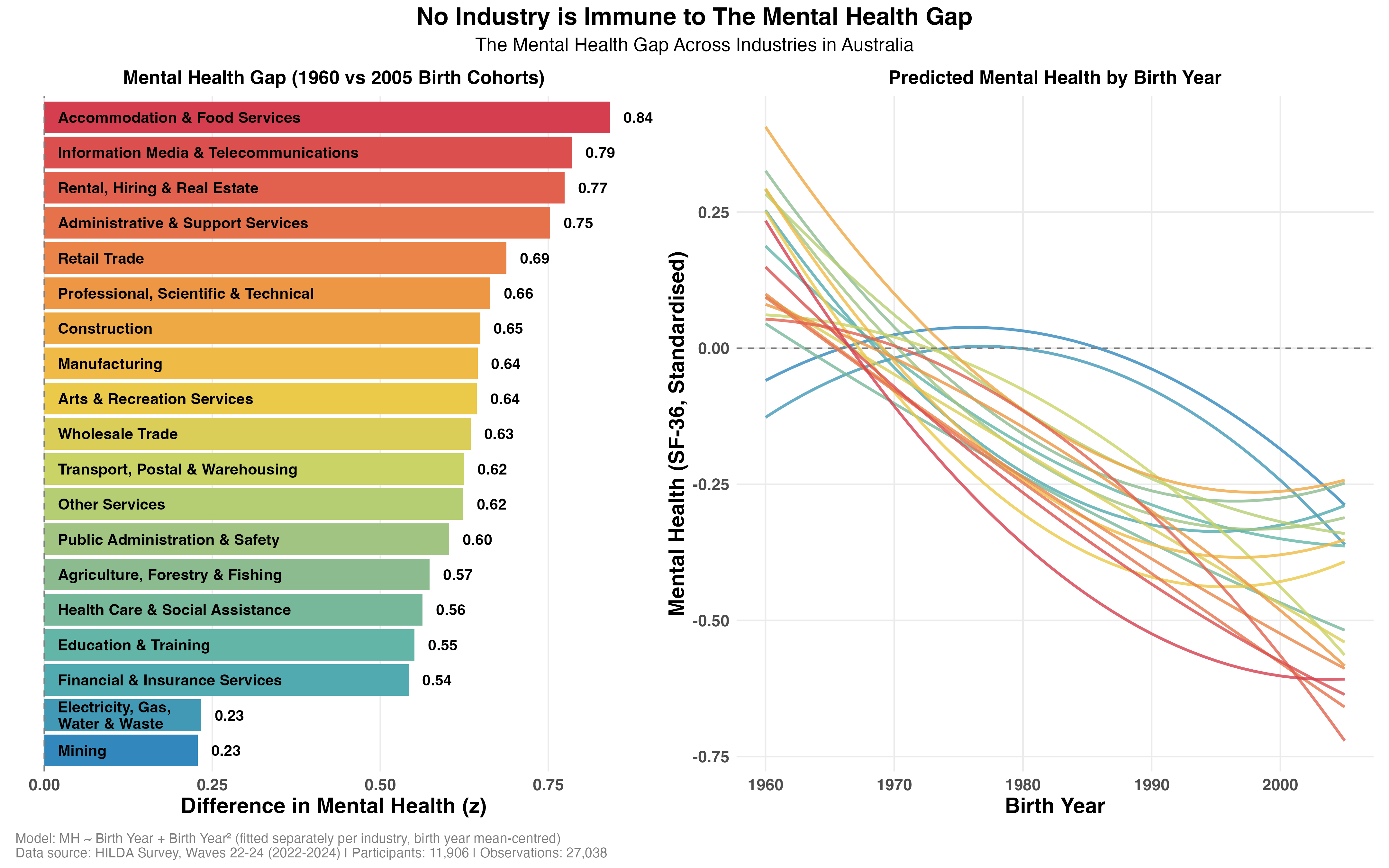
I took a closer look at the data to try and answer this question. The figure below shows the mental health gap two ways:
The left panel shows the expected difference in mental health between someone born in 1960 vs 2005, working in the same industry between 2022 and 2024. The right panel shows the predicted mental health trend across all birth cohorts for each industry over these years.
A note on units: these are in standard deviation units. For context, job loss typically reduces mental health by about 0.05 SD in this dataset. So these differences are not trivial.
The main finding is that the mental health gap exists in nearly every industry, but it varies in magnitude and form.
Largest gaps:
- Accommodation & Food Services (0.84)
- Information Media & Telecommunications (0.79)
- Rental, Hiring & Real Estate (0.77)
Smallest gaps:
- Mining (0.23)
- Electricity, Gas, Water & Waste (0.23)
- Financial & Insurance Services (0.54)
It's notable that the industries with the largest gaps tend to be customer-facing and fast-paced. On the other hand, there's something interesting about the industries with the smallest gaps: Mining and Utilities. The right panel shows these industries don't lack a mental health gap. It just takes a different form. In these sectors, workers born between 1970–1985 report the best mental health, with those born in the 1960s actually reporting worse outcomes than these middle cohorts. But even in these industries, younger workers report the lowest mental health of anyone.
So in nearly every other industry, the pattern is the same: younger workers consistently report the lowest mental health. The consistency suggests the drivers extend beyond any one industry's work design or culture. But that doesn't mean these factors don't matter. If anything, it makes them more important. Younger workers are arriving more vulnerable, which means organisations have an even greater responsibility to get work design, culture, and psychosocial safety right.