We all want a job that's interesting, uses our skills, and allows us to learn and grow. Not only are these qualities important for engagement, but they also support mental health and psychosocial safety. While every organisation is different, it turns out there are clear patterns in how engaging the work tends to be across different industries.
To investigate this, we analysed nearly two decades of Australian data (HILDA 2005–2023). We compared 19 industries based on six key features of job design: variety, complexity, skill-use, initiative, learning, and repetitiveness.
The 5 Most Engaging Industries:
- Education and Training
- Professional, Scientific and Technical Services
- Health Care and Social Assistance
- Public Administration and Safety
- Financial and Insurance Services
The 5 Least Engaging Industries:
- Accommodation and Food Services
- Transport, Postal and Warehousing
- Retail Trade
- Administrative and Support Services
- Wholesale Trade
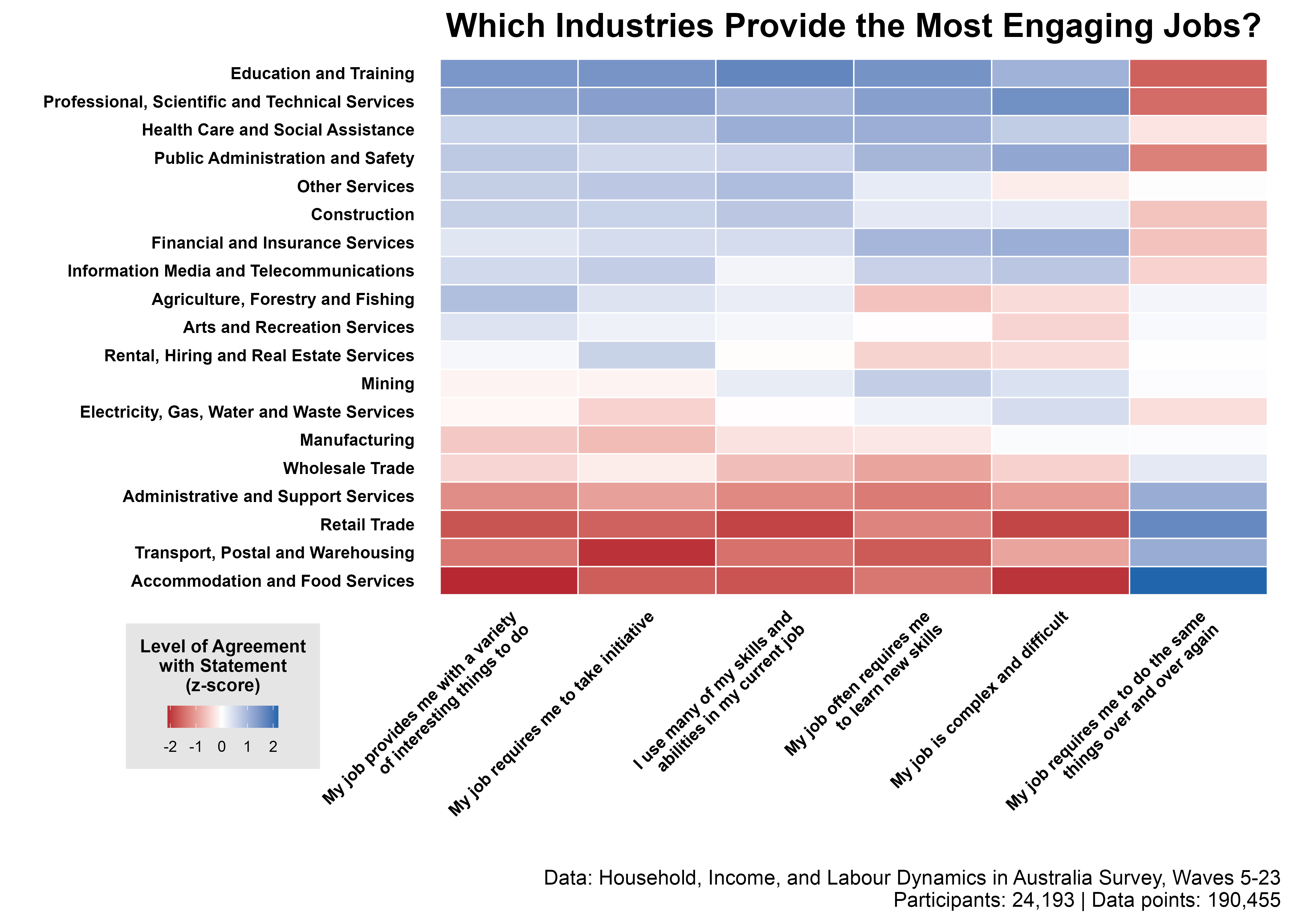
The findings suggest that knowledge-intensive industries like education, healthcare, and professional services tend to offer the most dynamic roles. Interestingly, these industries also tend to have higher levels of stress, suggesting that some of these job characteristics might be a double-edged sword. For example, while variety and learning opportunities are good, too much can be overwhelming.
In contrast, sectors with highly standardised processes and routine tasks tend to provide less of these characteristics. These industries often face unique pressures around cost, safety, and consistency that may require more structured approaches to work design. However, there's considerable variation within these industries, suggesting that some organisations have found effective ways to create more engaging roles despite these pressures.
For leaders, this is a reminder that job design is a powerful tool for attracting, retaining, and protecting great people. Even in industries with routine work, finding ways to increase variety and opportunities for learning can make all the difference.